A nanobubble claim is only as good as the method behind it. This page explains how we generate nanobubbles, how we measure them, and what our measurements show against untreated water.
Two ways we make nanobubbles
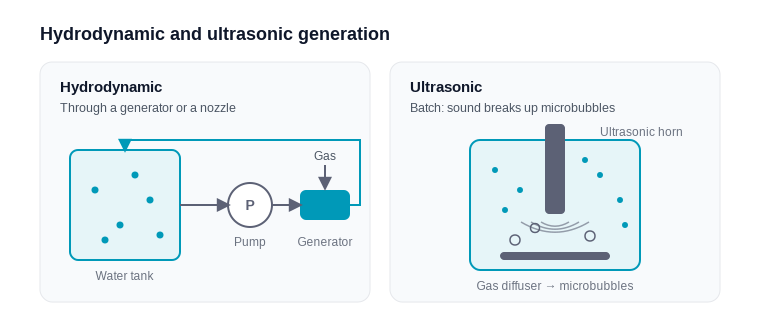
Hydrodynamic generation
Water is pumped through a generator or a nozzle, and the forces inside break gas into nanobubbles. We run it two ways. A generator on a tank loop, with gas injected, treats a volume continuously, which suits high-volume uses: process water lines, tanks and ponds. A nozzle in the line, our NBX, makes nanobubbles in a single pass with no recirculation, which suits dosing at the point of use. Our test rig logs dissolved oxygen, pH, ORP, temperature, pressure and gas flow continuously while it runs.
Ultrasonic generation
Gas is first released into water as fine microbubbles. Ultrasound then breaks those microbubbles into nanobubbles. It runs in batches and works with oxygen, carbon dioxide, nitrogen and air, so it suits uses where small bubble size matters.
How we measure
Nanoparticle tracking analysis (NTA)
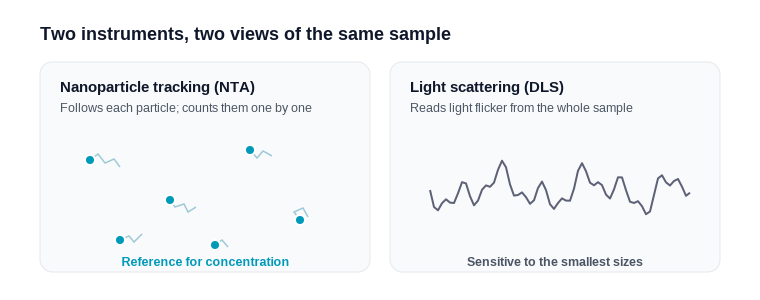
Our main instrument is a Malvern NanoSight. A laser lights the particles in a sample, a camera records each one's random movement, and the software works out each particle's size from how fast it moves. NTA counts particles one at a time, so it gives both size and concentration directly. It is our reference method.
Dynamic light scattering (DLS)
We also use a Malvern Zetasizer. DLS measures how scattered light flickers as particles move, and from that estimates a size distribution for the whole sample. It is fast and especially sensitive to the smallest particles. Its concentration estimates for bubbles, though, depend on assumptions about the particles, so we use it as a second view rather than the headline.
Every result is measured against a control
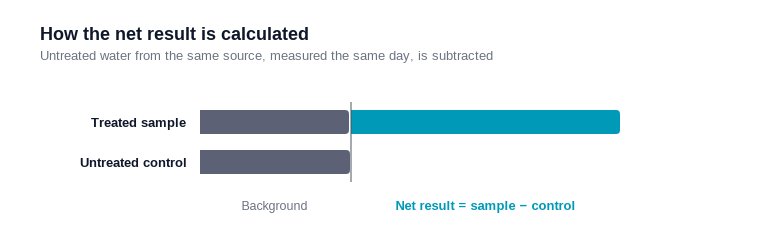
Ordinary water already contains particles in the same size range as nanobubbles. So for every test we:
- Measure untreated water from the same source on the same day, and report the treated sample minus that control.
- Take repeated captures of each sample, and report the average with its spread.
- Hold instrument settings fixed across a session, so samples can be compared.
- Test differences statistically, not by eye.
What we have measured
Ultrasound multiplies the nanobubble count
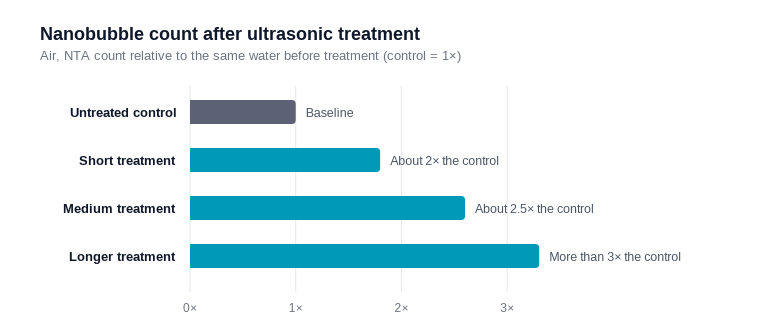
Against the same water before treatment, ultrasonic generation raised the nanobubble count to more than three times the control, and longer treatment gave more. It also shifted the size distribution toward smaller bubbles, with oxygen giving the smallest. DLS on the same system reports a population concentrated well below 100 nm. We quote NTA as our reference, for the reasons above.
Hydrodynamic generation: what changes the output and what doesn't
Three findings from our hydrodynamic tests shaped how we design systems:
- More gas is not more bubbles. Raising the oxygen flow raised dissolved oxygen, but the nanobubble count stayed the same.
- Recirculating doesn't keep adding bubbles. Passing the same water through the generator repeatedly did not build up the count. After several passes it was lower than after one.
- One pass through a nozzle is enough. In NanoSight sessions on three days, a prototype NBX nozzle raised the count to 1.5 to 2.2 times the same-day tap-water control in a single pass, at about 3 bar and 11 L/min, with no gas injected.
Oxygen: supersaturation that lasts
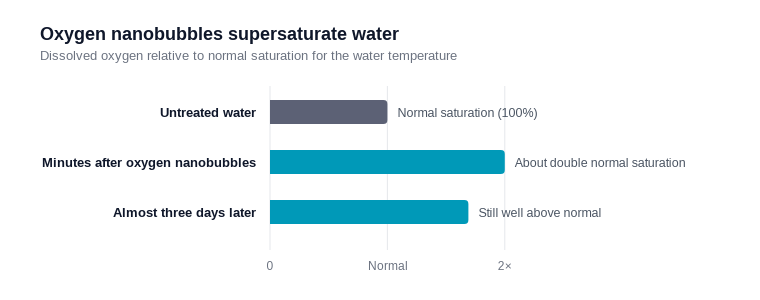
With oxygen, the hydrodynamic system took water to about double its normal dissolved-oxygen saturation within minutes. In a follow-up run, dissolved oxygen was still well above normal almost three days after treatment stopped. Elevated dissolved oxygen is a separate effect from nanobubbles; see Nanobubble Facts.
How long they last
In our measurements, nanobubbles remained above the untreated-water background for days after generation. For the most consistent results, we design for generation at or near the point of use.
Want to discuss the data, or test nanobubbles in your own process water? Contact our team.