Nanobubbles are gas bubbles too small to see, rise or pop the way ordinary bubbles do. They come up in semiconductor cleaning, aquaculture, irrigation and skincare, and they attract a lot of marketing. This page sets out what the science supports, what is still debated, and what we have seen in our own lab.
The definition
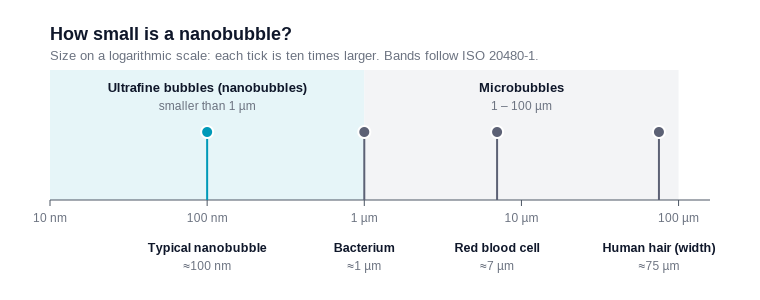
The international standard ISO 20480-1 calls them ultrafine bubbles: gas bubbles smaller than 1 µm (1,000 nm) across. Bubbles from 1 to 100 µm are microbubbles, and together the two are called fine bubbles. "Nanobubble" is the everyday name for ultrafine bubbles, and most of the ones that matter in practice are around 100 nm.
Why they behave differently from ordinary bubbles
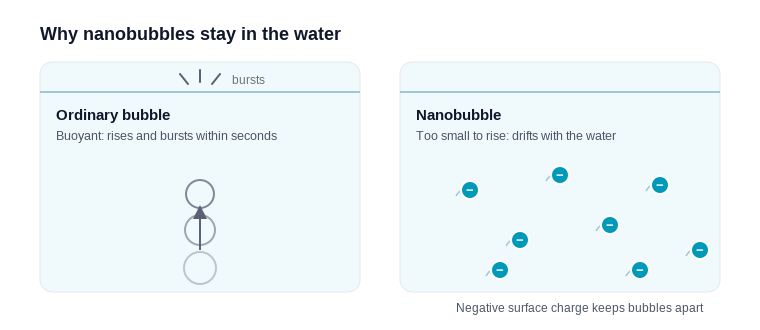
A bubble you can see is buoyant: it rises to the surface and bursts within seconds. A nanobubble is so small that buoyancy is negligible next to the random jostling of water molecules (Brownian motion), so it stays suspended in the liquid instead of rising.
That small size brings two properties that make nanobubbles useful:
- A very large gas–water interface. Water holding vast numbers of nanobubbles has far more bubble surface than the same volume of gas in large bubbles. That interface is where gas transfer and surface interactions happen.
- A charged surface. In water, nanobubbles typically carry a negative surface charge (measured as zeta potential), which varies with pH and dissolved salts. The charge makes bubbles repel one another, which slows them merging into larger bubbles.
The open question: why do they last at all
Classical physics says nanobubbles should not last. The pressure inside a bubble rises as it gets smaller. For a 100 nm bubble it is close to 30 atmospheres, which should drive the gas to dissolve within a fraction of a second.
Yet many laboratories, including ours, measure nanobubble populations that persist for hours to days. Why is still debated. Proposed explanations include the surface charge, layers of contaminants that slow gas escape, and the surrounding water being saturated with gas. Anyone who tells you the mechanism is fully settled is overselling.
There is also a measurement problem. The most common instruments cannot tell a nanobubble from a solid nanoparticle of the same size, and ordinary water already contains a large background of particles in that size range.
How long do nanobubbles last
Long enough to use. In our own tests, nanobubbles remained above the untreated-water background for days after they were made.
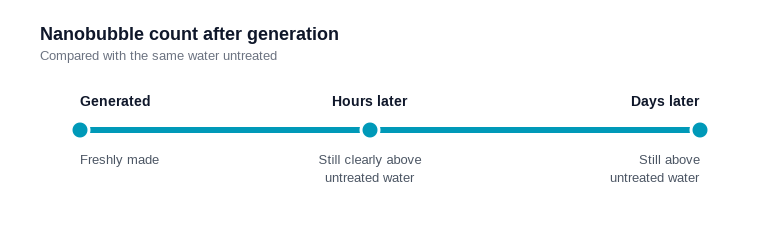
How long they last depends on the gas, the water and how it is stored. For the most consistent results, we generate nanobubbles at or near the point of use.
Nanobubbles and dissolved oxygen are not the same thing
Oxygen nanobubble systems are often sold on dissolved oxygen (DO): how much oxygen the water holds in solution. Generating oxygen nanobubbles can push DO well above normal saturation, and in our tests that elevated DO lasted for days. But high DO and the presence of nanobubbles are separate measurements. A system can raise DO through ordinary gas transfer without leaving many nanobubbles behind. When a supplier quotes DO figures, ask whether nanobubble counts were measured too.
Where nanobubbles are used
- Cleaning and surface treatment. Bubble interfaces attract and lift particles and oily soils from surfaces; our bench results cover this.
- Aquaculture and water treatment. Oxygen delivery to ponds and tanks, and support for the bacteria that break down ammonia.
- Agriculture. Oxygen-enriched irrigation water for the root zone.
- Medicine and skincare. Research into delivering gases and active ingredients.
Evidence differs a lot between these fields. Some rest on controlled studies; others are still mostly vendor claims.
How to judge a nanobubble supplier's claims
- What instrument measured the bubbles? Nanoparticle tracking analysis (NTA) counts individual particles. Dynamic light scattering (DLS) infers size from the whole sample, and its concentration estimates are less reliable for bubbles. The two can disagree by orders of magnitude.
- Was a control subtracted? Untreated water from the same source, measured the same day, should be reported alongside the result.
- When was it measured? A count taken moments after generation says little about the water that reaches your process.
- Is it bubbles or dissolved gas? Dissolved-oxygen gains are real and useful, but they are not proof of nanobubbles.
- Single run or repeated? Nanobubble results vary from run to run. Ask how many repeats stand behind a number.
We hold our own data to the same questions. If you want to see the evidence behind anything on this site, get in touch.