The problem today
Parts are cleaned today by filling, agitating, and repeating: an ultrasonic bath, run cycle after cycle until the particle count stops falling. Every cycle costs an hour and a full fill.
The turnaround between strip-down and rebuild is set by how many of those cycles a part needs.
Where nanobubbles fit in your line
Nanobubble water goes into the bath the parts already sit in. It changes what the liquid does at the surface: contamination releases sooner and stays suspended instead of settling back, so the count comes down in fewer passes.
- No ultrasonic energy, and no change to your chemistry.
- The working fluid is the same water with gas dissolved into it.
- A negative surface charge on the bubbles helps keep lifted particles from settling back onto the part.
Nothing to qualify
Parts are cleaned before they ever reach the fab, so there is no in-fab tool qualification to clear.
Data
Bench test: varnished galvanized-steel coupons (2 × 4 cm), each given the same dried film of cerium oxide (CeO₂), a fine polishing powder, were dip-agitated gently in nanobubble water (air or oxygen) or in tap water for 2 or 5 hours. Each of the four runs had three nanobubble coupons and one tap-water control. The same microscope field was photographed before and after. The result is the share of that field newly exposed once the particle film was removed.
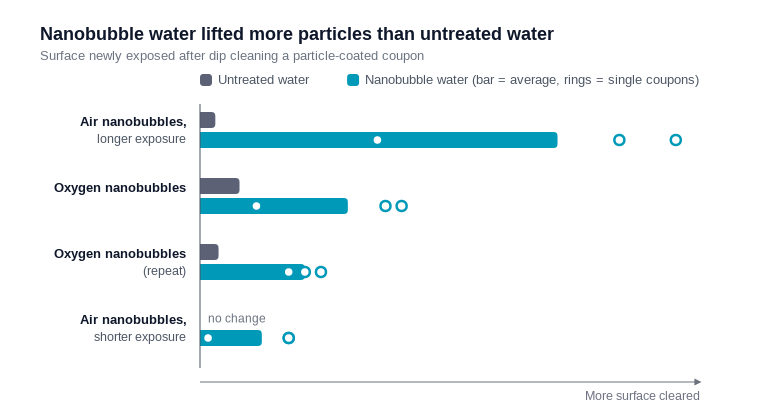
In all four runs the nanobubble coupons exposed more of the field, on average, than the control: 0.8 to 4.4% against 0.5% or less, and several coupons by 5 to 10×. Tap water alone barely moved the film, and in one run it removed none. The 5-hour run gave the largest effect.
Full method and results · How we make and verify nanobubbles
How it installs
Bubbles are dosed into the water at the point of use and stay stable for a full shift, so the working fluid is still water, delivered through the plumbing you already have.
- No new tooling, and no change to how the bath is run.
- No ultrasonic transducers to maintain.