Nanobubble cleaning is widely promoted, from fabs to laundries. Before we make claims for a process, we test the effect at bench scale against what it would replace, the same water without nanobubbles, under the same conditions. This page reports those tests and what they show.
Why nanobubbles help cleaning
Nanobubbles collect at surfaces. Their gas–water interface attracts hydrophobic soils and fine particles, and their surface charge can help keep loosened particles from settling back. The aim is to loosen contamination with water and gentle agitation, using less heat, chemistry or ultrasonic energy than conventional cleaning.
Test 1: Particle removal from coated coupons
The question: does nanobubble water lift fine particles off a surface faster than untreated water under gentle agitation?
Method:
- Coupons: varnished galvanized-steel test pieces (2 × 4 cm), each given the same dried film of cerium oxide (CeO₂), a fine polishing powder.
- Cleaning: coupons dip-agitated gently in nanobubble water (air or oxygen) or tap water for 2 or 5 hours. Each of the four runs had three nanobubble coupons and one tap-water control.
- Measurement: the same microscope field photographed before and after. The result is the share of that field newly exposed once the particle film was removed.
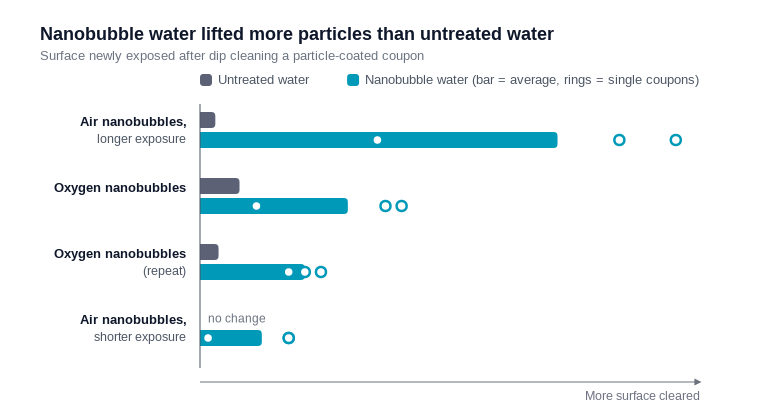
Results: in all four runs the nanobubble coupons exposed more of the field, on average, than the control: 0.8 to 4.4% against 0.5% or less, and several coupons by 5 to 10×. Tap water alone barely moved the film, and in one run it removed none. The 5-hour run gave the largest effect.
Test 2: Cleaning the inside of tubes
The question: does nanobubble water clear deposits from tubing faster than tap water at the same valve setting?
Method: eight transparent tubes, coated on the inside with poster paint and dried for three days, then flushed with either nanobubble water or tap water, four tubes each, at the same valve setting (2.2 to 2.4 L/min). A camera tracked how much of each tube had cleared over time.
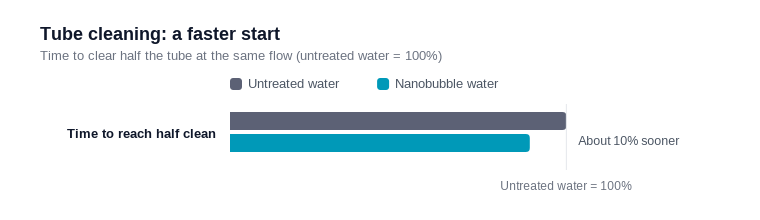
Results: nanobubble water got to work faster. On average it took 123 s of flow to clear half of a tube, against 138 s for tap water: about 10% sooner. Partway through the flush every nanobubble tube was ahead of every tap-water tube. By the end of the flush both groups were about 90% clear.
What this means: faster early removal matters most where cleaning time or rinse volume is the constraint, such as flushing pipework and lines between batches.
Where this leaves us
Across these tests, nanobubble water consistently helped loosen contamination at bench scale compared with untreated water. The size of the effect depends on the soil, the surface and how long contact lasts. The next step is to test on production materials and contaminants, with industry-standard measurements such as liquid particle counts, working with partners on their own lines.
If you clean parts, pipework or vessels and want to test nanobubble water on your own contamination, talk to us.